Heart Rate Zone Calculator
Compare 4 science-based heart rate formulas in one calculator
Uses gender-specific formulas and optional resting heart rate for more personalized results than basic age-only calculators. Free, instant, and 100% private.
Quick Answer: How to calculate heart rate zones
Enter your age to instantly calculate all five heart rate zones. The calculator uses Tanaka (men), Gulati (women), and Karvonen when a resting heart rate is provided.
Find your Zone 2 and full training zones in seconds.
Calculate Your Heart Rate Zones
Disclaimer: This calculator is for informational purposes only and does not provide medical advice. Always consult with a healthcare professional before starting any new exercise program.
What Is a Heart Rate Zone?
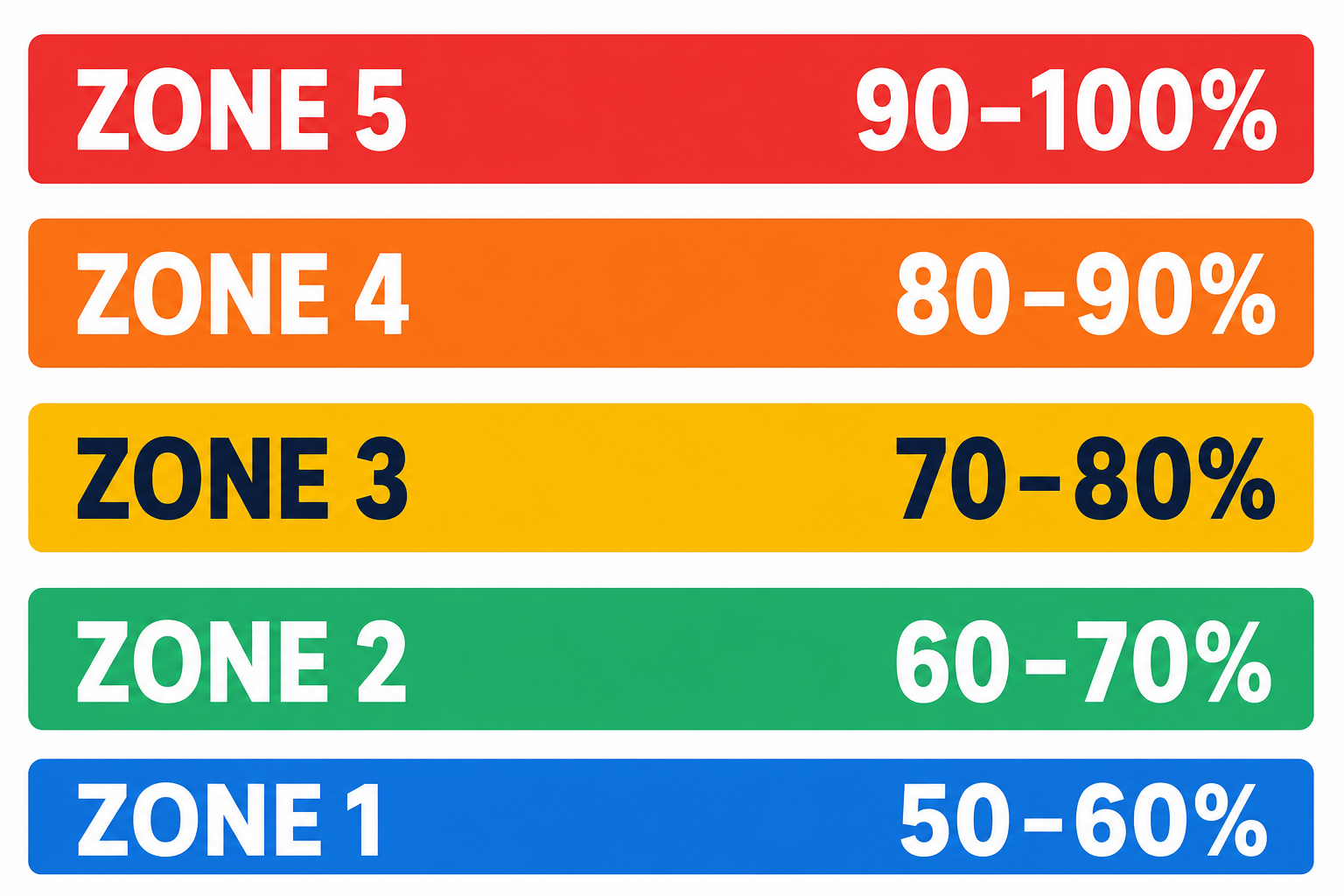
A heart rate zone is a defined range of heartbeats per minute (bpm) that corresponds to a specific exercise intensity. There are five zones, numbered 1 through 5, each calculated as a percentage of your maximum heart rate (max HR). Zone 1 (50–60% max HR) is the lightest, while Zone 5 (90–100%) is all-out effort.
- •Zones are used to target different energy systems and training adaptations
- •Lower zones (1–2) build aerobic base and burn fat efficiently
- •Higher zones (4–5) improve speed, power, and VO₂max
- •Most smartwatches (Garmin, Apple Watch, Polar) use this same 5-zone model
This calculator estimates your zones from your age and optional resting heart rate using gender-specific formulas validated in peer-reviewed research. For a deep dive, see our complete guide to heart rate zones.
What Is Zone 2 Heart Rate?
Zone 2 heart rate is 60–70% of your maximum heart rate — the intensity where you can hold a full conversation while exercising. It is the most important zone for building aerobic base, improving fat oxidation, and stimulating mitochondrial biogenesis. A 30-year-old man with a max HR of 187 bpm (Tanaka) has a Zone 2 range of approximately 112–131 bpm.
🔥 Fat burning
Highest percentage of calories from fat oxidation
🧬 Aerobic base
Builds mitochondria and cardiovascular efficiency
💬 Talk test
You can hold a full conversation at this intensity
Zone 2 is the intensity most endurance programs use to build mitochondrial adaptation and aerobic base. It's the foundation of the 80/20 polarized method and a key component in evidence-based fat loss.
→ Age-specific Zone 2 tables, running vs cycling differences, and weekly plans in our Zone 2 Heart Rate Training Guide.
Heart Rate Zones Explained
Most training programs — and devices from Garmin, Polar, and Apple Watch — use a five-zone model:
| Zone | % Max HR | Feel | Primary Benefit |
|---|---|---|---|
| Zone 1 | 50–60% | Very easy | Recovery, warm-up |
| Zone 2 | 60–70% | Conversational | Aerobic base, fat oxidation |
| Zone 3 | 70–80% | Moderate | Tempo endurance |
| Zone 4 | 80–90% | Hard | Lactate threshold |
| Zone 5 | 90–100% | All-out | VO₂max, peak power |
Each zone trains different energy systems and produces distinct adaptations. For a detailed breakdown, see our complete guide to heart rate zones.
Max Heart Rate Formulas
Your max HR is the foundation of all zone calculations. Three validated formulas exist:
| Formula | Equation | Best For |
|---|---|---|
| Fox | 220 − age | Historical reference only |
| Tanaka | 208 − 0.7 × age | Adults over 40 (18,712 participants) |
| Gulati | 206 − 0.88 × age | Women (5,437 participants) |
All formulas carry ±10–15 bpm uncertainty. Compare results side by side with our max heart rate calculator.
Karvonen Method
The Karvonen method calculates heart rate training zones using your heart rate reserve (HRR = max HR − resting HR). Unlike simple percentage-based methods, it accounts for your fitness level through resting heart rate. The formula is: Target HR = Resting HR + (Intensity% × HRR).
Formula:
Target HR = Resting HR + (Intensity% × HRR)
Enter your resting heart rate in the calculator above to activate Karvonen zones. For worked examples, see our Karvonen method guide.
Heart Rate Zones for Running vs Cycling vs Swimming
Your zone ranges in bpm are the same regardless of activity — but your heart rate response at a given effort varies significantly between sports.
Running
- • Highest HR at given effort
- • Weight-bearing raises demand
- • Easy pace = Zone 2
- • Tempo pace = Zone 3–4
Cycling
- • 5–10 bpm lower than running
- • Seated position reduces demand
- • Zone 2 = easy spin for hours
- • Power meters complement HR
Swimming
- • 10–15 bpm lower than running
- • Horizontal + water pressure
- • Subtract 10 bpm from land zones
- • Harder to measure mid-swim
→ Cyclists: see our cycling heart rate zones guide for sport-specific zone tables and power vs HR analysis.
80/20 Polarized Training
Dr. Stephen Seiler's research shows world-class endurance athletes consistently train 80% in Zones 1–2 and 20% in Zones 4–5, largely avoiding the moderate "gray zone" (Zone 3).
Why Zone 3 is minimized
Too stressful for quick recovery, not intense enough for elite-level adaptations. The result: chronic fatigue without proportional performance gains.
→ Weekly plan examples in our 80/20 polarized training guide.
Common Mistakes When Training by Heart Rate
Training too hard on easy days
Zone 2 should feel almost too easy. Most recreational athletes drift into Zone 3 on recovery days, accumulating fatigue without proportional benefit.
Using the wrong formula
Using the old Fox reference (220 − age) puts most zones 5–10 bpm too high, especially for women. Use gender-appropriate formulas — Gulati for women — for accurate ranges.
Ignoring environmental factors
Heat, humidity, altitude, and caffeine all affect HR. On hot days, your Zone 2 pace will be slower. Trust the bpm target, not the pace.
Trusting wrist HR at high intensity
Optical wrist monitors struggle during intervals and strength training. For Zone 4–5 work, a chest strap is significantly more reliable.
Treating formulas as absolutes
Max HR formulas have ±10–15 bpm uncertainty. The only way to know your true max HR is a supervised maximum effort test.
Heart Rate Monitor Accuracy: Wrist vs Chest Strap
Wrist monitors
Accurate for Zone 1–2 steady-state cardio (±5 bpm). Lag behind actual HR by 30–60 seconds. Fine for easy runs and rides.
Chest straps
Near-ECG accuracy (±1–2 bpm) with instant response. Essential for Zone 4–5 interval work and race efforts.
When to Consult a Medical Professional
These are training estimates, not medical advice. Talk to a qualified health professional before starting or changing a training program, and especially if you:
- •Have been sedentary for an extended period and are over 40
- •Have a history of heart disease, high blood pressure, or stroke
- •Experience chest pain, palpitations, or dizziness during exercise
- •Have diabetes or conditions affecting cardiovascular function
- •Are pregnant or postpartum
- •Take medications that affect heart rate (e.g., beta-blockers)
Explore Training Guides & Calculators
Heart Rate Zones Explained
Complete guide to all five training zones — what they are, how to calculate them, and when to use each one.
Zone 2 Heart Rate Guide
Mitochondria, fat oxidation, by-age tables, and running vs cycling differences.
Max Heart Rate Calculator
Compare Fox, Tanaka, and Gulati formulas side by side.
Fat Burning Zone Calculator
Find your optimal fat oxidation range for endurance and metabolic health.
Cycling Heart Rate Zones
Sport-specific zones, sweet spot training, and power vs HR analysis.
80/20 Polarized Training
Dr. Seiler's research, zone distribution, and weekly training examples.
Karvonen Method Explained
Heart rate reserve formula, worked examples, and who benefits most.
Beginners Guide
New to HR training? Simple weekly plan and the only two zones you need.
Zone 2 & Fat Loss
Is Zone 2 best for fat loss? What the science says about fat-burning zone vs total calories.
Calculate Your Zones (Step-by-Step)
Manual calculation guide using %MHR and Karvonen methods.
Resting vs Max Heart Rate
What each metric means and why heart rate reserve matters for zone accuracy.
Reviewed Based on Peer-Reviewed Exercise Physiology Research
All content on this site is based on peer-reviewed exercise physiology research. We do not provide medical advice.
- • Gulati, M. et al. (2010). Heart rate response to exercise stress testing in asymptomatic women. Circulation, 122(2), 130–137. DOI
- • Tanaka, H., Monahan, K.D., & Seals, D.R. (2001). Age-predicted maximal heart rate revisited. JACC, 37(1), 153–156. DOI
- • Seiler, S. (2010). What is Best Practice for Training Intensity and Duration Distribution? IJSPP, 5(3), 276–291.
- • San Millán, I. & Brooks, G.A. (2018). Assessment of metabolic flexibility. Sports Medicine, 48(2), 467–479.